By Jonathan Whitcomb
Of course we mean the flying creature “pterosaur”, commonly called “pterodactyl”, when we here mention “flying dinosaur”.
.
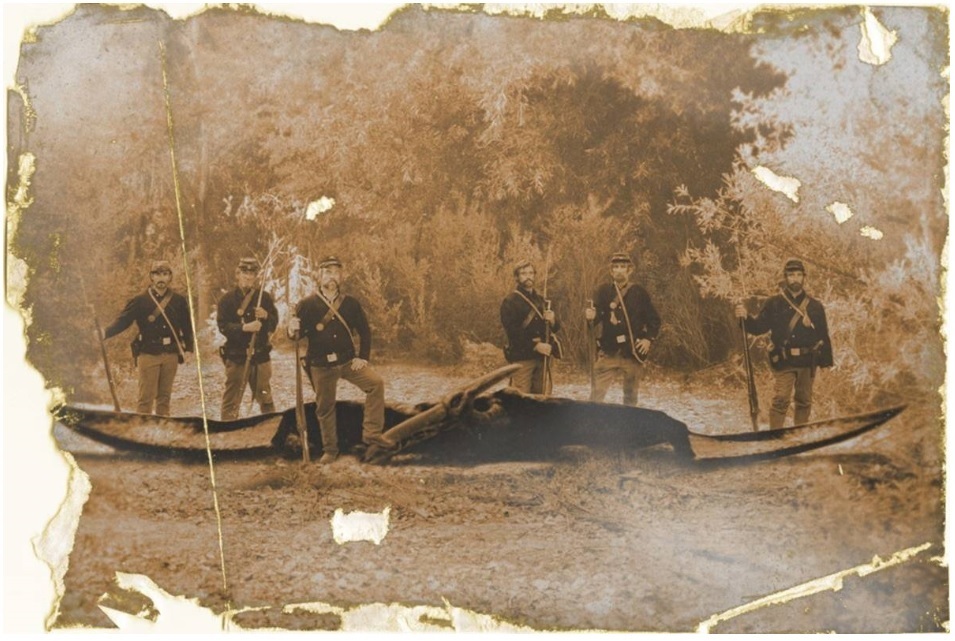 Ptp: the apparently old photo that has been controversial for years
.
In the last few weeks, I have been taking another look into the credibility of Ptp, what some people call the “Civil War pterodactyl photo.” Just in the last few days, I have seen a new significance in an observation made by Tom Payne some time ago: One of those six apparent Civil War soldiers is left handed. I looked for myself and found that the other five are right handed. How do we know that? It’s in the pistol holsters: One is on the left side; the other five, the right. We’ll get into that later.
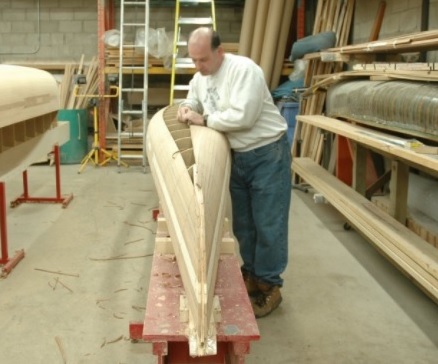
The canoe builder Tom Payne discovered the left-handed holster
By the way, the six men in Ptp were definitely NOT photographed during the American Civil War: Their rectangular belt buckles and pistol holsters make that plain. But it may have been a few years after that war, when some American soldiers did look like the men in Ptp, with rectangular belt buckles and pistol holsters.
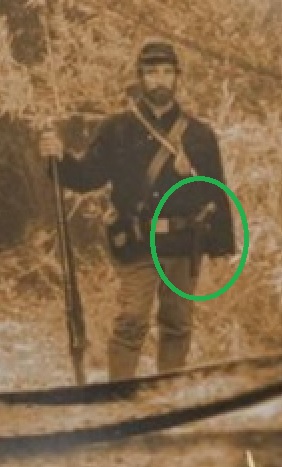
Pistol holster of the left-handed soldier in Ptp
.
The main objection to Ptp in recent years
Before diving into that left-handed holster, consider the principal apparent refutation of Ptp during the past four years, the main objection to its authenticity: an online article that I call “CWP”.
Before we proceed with the CWP declarations, be aware that at least three production firms were involved in the creation of the Freakylinks TV episode “Coelacanth This!”, which aired in the year 2000: Haxan Films, Freakylinks, and E=MC2 Digital. For simplicity, when referring to their combined work in producing that episode, I call them HFE, although how they worked together, combining their specialized activities, might have been complex in some details.
The present point on CWP and Ptp is this: What one executive or director remembers about what happened, in one detail, in the creation of that episode two decades ago—that does not necessarily closely relate to what actually happened, if that person was not directly involved in that detail of work done by the relevant firm.
To be more plain: E=MC2 Digital is credited in the CWP article with the image which could be called the “Civil War Pteranodon photo” in the TV episode, but the persons mentioned in CWP were not, apparently, in E=MC2 Digital itself.
I wish I could briefly explain this, but the reality is more complex than one would be led to believe by CWP. Here is an important point that we will get to later: The “Civil War Pteranodon photo” seen in Freakylinks episode “Coelacanth This!” is almost the same as Ptp yet is slightly different. In other words, strictly speaking, Ptp is NOT in that episode: “Ptp” is the whole image, and the bottom is missing in that TV episode.
(Remember that “HFE” refers to all three companies together.)
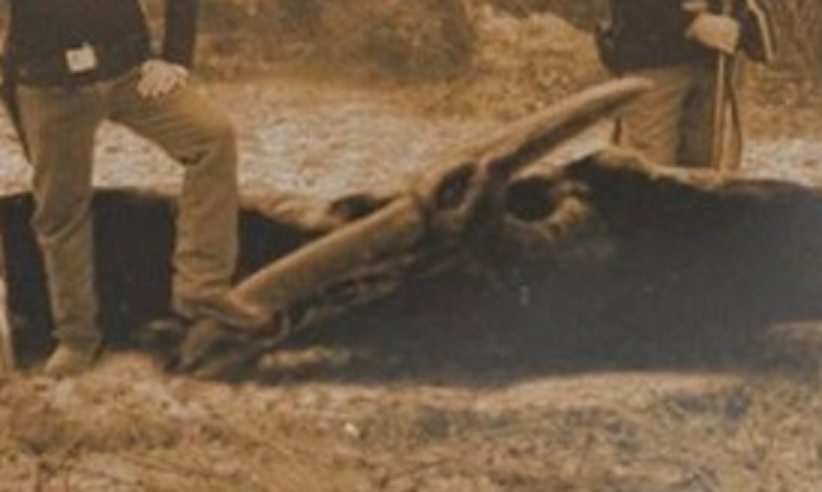
.
Declarations or Points in CWP
The CWP article makes, or seems to imply, four claims:
1. The six men in Ptp were photographed by HFE and that photo was used by E=MC2 Digital. Keep in mind that CWP is unclear about which members of HFE were involved with those six men. Who found them? Who got costumes for them? Who photographed them? Who knows?
2. E=MC2 Digital should be given credit for a digital model or drawing of a pterosaur, which we now see in Ptp, but be aware that this is the opinion of the author of CWP.
3. The first try in making a fake “Civil War Pteranodon photo” (AP) failed. One problem was said to be this: They forgot to get release signatures from the soldier-actors. Another problem was the poor quality of the fake “pterodactyl”, which looked unconvincing in the final “photo”. CWP declares that the image of Ptp was a second hoax photo, so that the men photographed could sign release forms. [But claim #3 has MANY problems.]
4. CWP says or implies that the episode itself proves the origin of Ptp.
Let’s begin with the fourth point: It has recently been proven WRONG.
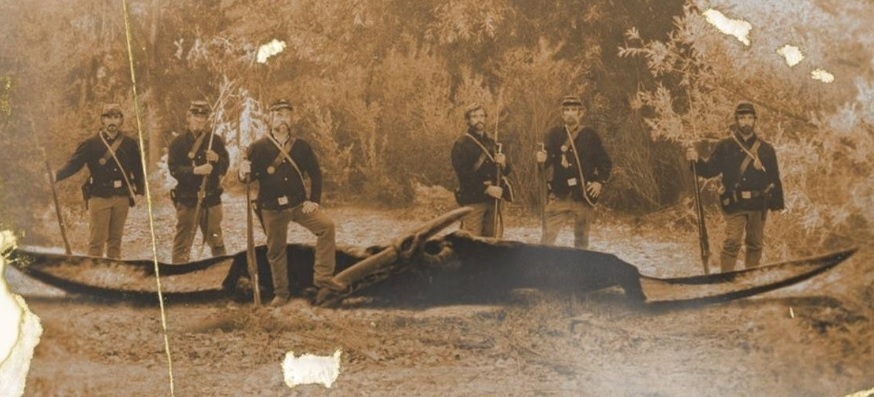 Part of Ptp: with the bottom and top areas missing
.
CWP point #4 (the episode is the source)
Ptp appears, at first glance, to be in four places in that episode. In one Youtube video of “Coelacanth This!”, it seems to be in the following places (minutes and seconds from the beginning of the video):
30:06-30:10
30:21-30:27
30:56-31:07
42:04-42:09
A close inspection, however, reveals that nowhere in those clips does the complete image of Ptp appear. That means that nobody could have taken a still image from that episode and inserted it into an online page or Youtube video in a way that shows the entire image of Ptp, even if that person combined two or more images from that episode.
In other words, the complete images of Ptp found online in recent years did not come from that episode. In addition, the simple existence of that episode, with partial versions of Ptp, is not evidence for CWP’s origin-idea on Ptp.
The author of the CWP article seems to have been unaware of his own assumptions, thinking perhaps that the images of Ptp found online in recent years somehow originated with that TV episode.
.
CWP point #3 (two fake “Civil War” photos)
 Tom Payne
Tom Payne sent me an email in January of 2017, when he was 67 years old, and told me that he had seen Ptp in a publication when he was young. About how young was he? These are his words: “I have a degree in computer science. I can tell you that technology wasn’t available to modify a photo like this before about 1980.”
In other words, according to his testimony, Ptp existed long before any episode of Freakylinks, probably decades earlier. Keep in mind that he is only one of a number of persons who have told me that they had seen Ptp long before the beginning of the 21st century, generally around the 1960’s or 1970’s.
Considering an online statement from E=MC2 Digital, I state this: If Ptp existed before the Freakylinks episodes, and some members of the three firms of HFE were aware of that image, then any request to construct a fake photo that looked like Ptp could have been answered with something like, “why not use that image itself?”
The first response to that question could have been something like, “We don’t have permission to use a copyrighted image and we don’t have talent releases from those six men.” Note especially the last part of that answer.
If one person in HFE later learned that the image (what we now call “Ptp”) was in some print publication before the year 1923, then they could feel it was safe regarding copyright: It would be in the public domain. But there could have been another issue.
A talent release for a photo differs from copyright issues. If somebody in HFE found a publication with that [Ptp] image, but it was from the middle of the 20th century, a talent release could have appeared, at least on the surface, to be a major obstacle: Could one of those six men still be living?
.
Which “Civil War pterodactyl photo” came first?
As of October 4, 2022, I have not been 100% convinced that Ptp existed before the year 2000, yet I am well over 50% sure of it. I feel that it is possible that the people who say they saw it many decades ago could have mistaken it for a similar old photo that was published in a book or magazine around the middle of the 20th century. I say “possible”, but I doubt that.
The apparent pterosaur photo labeled “AP” (for “advance publicity”) is a hoax, with hardly anyone doubting that. The following is one of the actors, who is too heavyset to be a reasonable imitation of an American Civil War soldier:
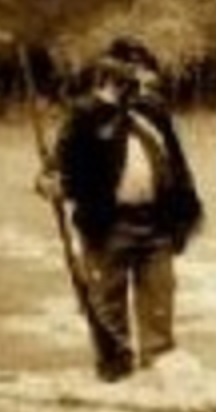
NOT from Ptp but from the AP fake photo
The author of CWP seems to assume that the AP photo was the first one handled by Freakylinks and that Ptp came later. Where is the evidence for that? The two men mentioned in CWP show no signs that they were personally involved in the creation of either image, although I would not be surprised if they had at least some part in creating AP.
.
CWP point #2 (E=MC2 Digital made the pterodactyl or paid for it)
Should E=MC2 Digital be given credit for a digital model or drawing of the apparent pterosaur we see in Ptp? Where then is the evidence that they have ever taken credit for it? The author of CWP may assume that the name of that firm in the credits of that episode is enough. Why assume that?
As I write this, on October 5, 2022, I admit that I may be mistaken. Perhaps E=MC2 Digital obtained permission from some artist or scientific organization, regarding the use of a detailed drawing of a dead Pteranodon, or some similar pterosaur. But since I’ve found no evidence of that in my online searching, I’ll now dive into another possibility, one supported by direct eyewitness experience rather than second-hand or third-hand accounts or only by assumptions.
Take the case that Tom Payne and other persons are correct: that they did see Ptp in some publication in the middle of the 20th century. Why not look for evidence in the image itself?
By the way, could HFE have created a physical model of the pterosaur seen in Ptp? That has been shot down. (Of course the AP fake pterodactyl was a physical model, poorly constructed by some standards, but keep in mind that this was for one episode of a TV show, nothing like a big-budget film.) The apparent pterosaur in Ptp, on the other hand, is much too detailed biologically. Even the neck alone shows evidence of authenticity with a detailed muscular structure.
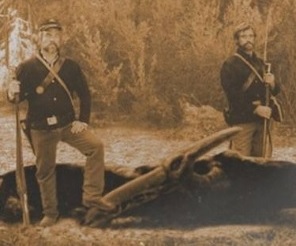
.
Evidences that the apparent pterosaur was a real object
If this was a real object like a genuine pterosaur or a detailed model of one, could not the overall image of Ptp have evidence of that? First consider the case for the real “pterodactyl”, a biological flying creature.
If those six men shot down that animal and it fell from the sky, what would we expect? It could have fallen into the middle of a clearing or onto a tree or underbrush or into a lake or pond.
If they found it alive in a tree or in the underbrush, they might have shot it there. But it’s unlikely that it fell conveniently into the middle of a clearing where it could be photographed without any need to move it.
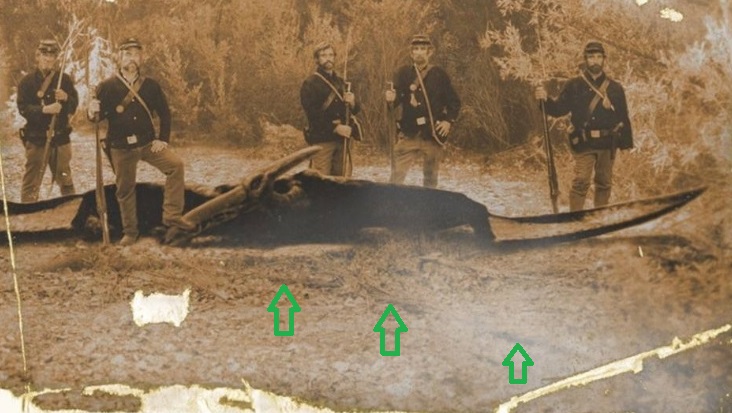
Drag mark on the ground, indicating where it was dragged from
The bottom of Ptp is not shown in the episode “Coelacanth This!” Why should it be? It looks irrelevant: dirt and grass. But there’s more to it.
If it had been a real animal photographed in the second half of the 19th century, the photographer would have insisted that it be dragged into a clearing where it could be photographed with adequate light.
The green arrows above show the apparent direction that this thing was dragged. Let’s dig deeper.
If that drag mark was made by the end of the beak of the animal, why does the line in the soil not end up right where we see the end of that beak? We have an answer.
The dragging of the beak across the ground would have caused the head to be twisted. In the final positioning of the animal, the men would have turned the head back to its natural position, giving a better view of it for photographing.
The men could also have made adjustments to the wings, spreading them out. During those adjustments, the end of the beak could have ended up a bit away from where it was last dragged across the ground.
If this apparent pterosaur was a real object, the drag mark does make sense. It makes no sense in the case for a digital model or drawing except to say that the line in the soil was just a coincidence.
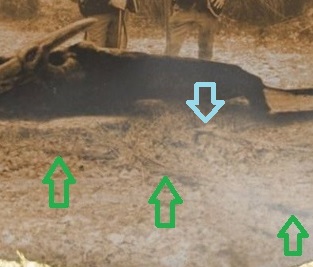
Broken down little sapling tree (blue arrow)
Not all forest clearings are 100% clear. What if a little tree stood in the middle of this particular clearing? Look again at the drag mark. Why does that nearby plant appear to have been broken down, like one of those men stepped on it? That unfortunate little sapling was standing exactly in the way, apparently. Could it be a coincidence, next to that other coincidence? It’s unlikely, and there is much more.
.
CWP point #1 (Evidences those men lived in the 19th century)
Let’s keep looking into the case for the apparent pterosaur being an actual pterosaur. If the animal was real, those six men were very likely real; likewise, if those men were photographed, in the 19th century, next to an apparent pterosaur then it was very likely a real pterosaur. We now examine the men closely.
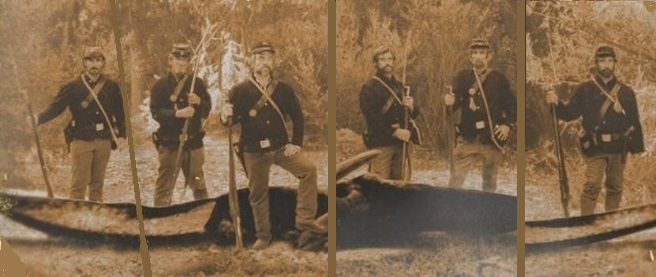
A contraction of Ptp, showing the men closer to each other
First notice the general build. These men look better fed than many common Union soldiers during the American Civil War. Yet not one of these six is as heavyset as many Civil-War reenactors who actually lived from about the middle of the 20th century to the present.
Keep in mind that if these six men ate together and lived together, they would likely appear just like we see in this image: six men who are individuals with differing in personalities yet having things in common. Notice the many similarities: beard styles are not identical but are consistent; uniforms and equipment are very similar, including the belt buckles and holsters; and we see similarities in the way they stand and hold their rifles: Not one rifle is held close to horizontally.
In other words, the appearance of the men seen in Ptp suggests they were being photographed together in the second half of the 19th century, after the Civil War had ended, rather than with six random actors who were trying to portray such men.
Also keep in mind that six men posing for a photo for a TV show would not likely be given detailed leadership from a professional director. It would have been nothing like filming for a movie.
Look at them again. Compare the build of those six with photos of Civil War reenactors (recent decades). Don’t the six men of Ptp look like they could have been eating together for many months? That is much too precise a detail for six random actors being photographed for a TV show. In addition, these are definitely NOT Civil War reenactors, for the combination of rectangular belt buckles and pistol holsters (with every one of them) show they were not reenactors being photographed in the year 2000.
My associates and I believe they were photographed in the 19th century but after the Civil War ended (rectangular belt buckles and the pistol holsters). Common Union soldiers, not officers or sergeants, during the Civil War had neither of those. This is more like Northern men living in the South during the Reconstruction era.
Consider what would be expected of six men in the second half of the 19th century regarding handedness. According to statistics, two possibilities are very likely: One out of six is left-handed or none are left-handed.
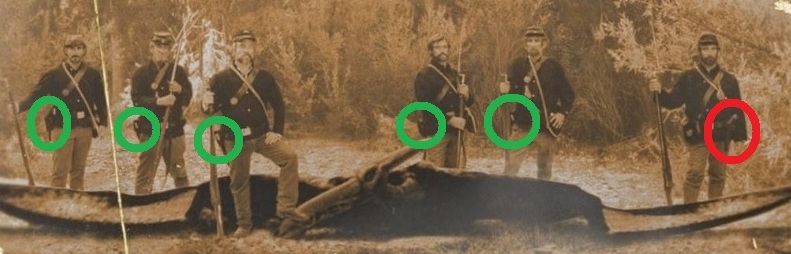
Statistical evidence: They were photographed in the 19th century
Now examine the pistol holsters of these six men: five have right-handed holsters and one has a left-handed one. This would be expected if these men had been photographed in the second half of the 19th century, but there’s a problem with the year-2000 hypothesis, the idea that these men were photographed in the year 2000 for that TV episode.
If one or more of the three firms of HFE (including E=MC2 Digital) had hired actors and provided uniforms for them, the costume company would not have given them pistol holsters with the precise ratio of handedness as would be expected for 19th century apparent Civil War soldiers. That would have been WAY too precise. On top of that, it seems unlikely that the costume company would have had even one left-handed holster, even if it had been requested.
And it gets worse for the case of year-2000 photography.
As best as I can tell from watching the episode “Coelacanth This!”, the script was written with the idea that a large, dangerous flying creature had lived during the conflict of the American Civil War. This is a basic part of the story. So why are the men seen in Ptp NOT dressed like Civil War soldiers? The CWP article dismisses this as just a mistake by the costume company.
The problem with that assumption is this: If the costume company was so careless, how could they be so accurate in portraying 19th century men, with the precise statistically-correct portrayal of one left-handed man and five right-handed men? (The costume company would probably not have had even one left-handed holster.)
.
###
.
The “Civil War” Pterosaur
Apparently the strongest objection to the authenticity of the original version of the Ptp “pterodactyl photo” is a web page titled “The Civil War Pterosaur”, which I label “CWP”.
.
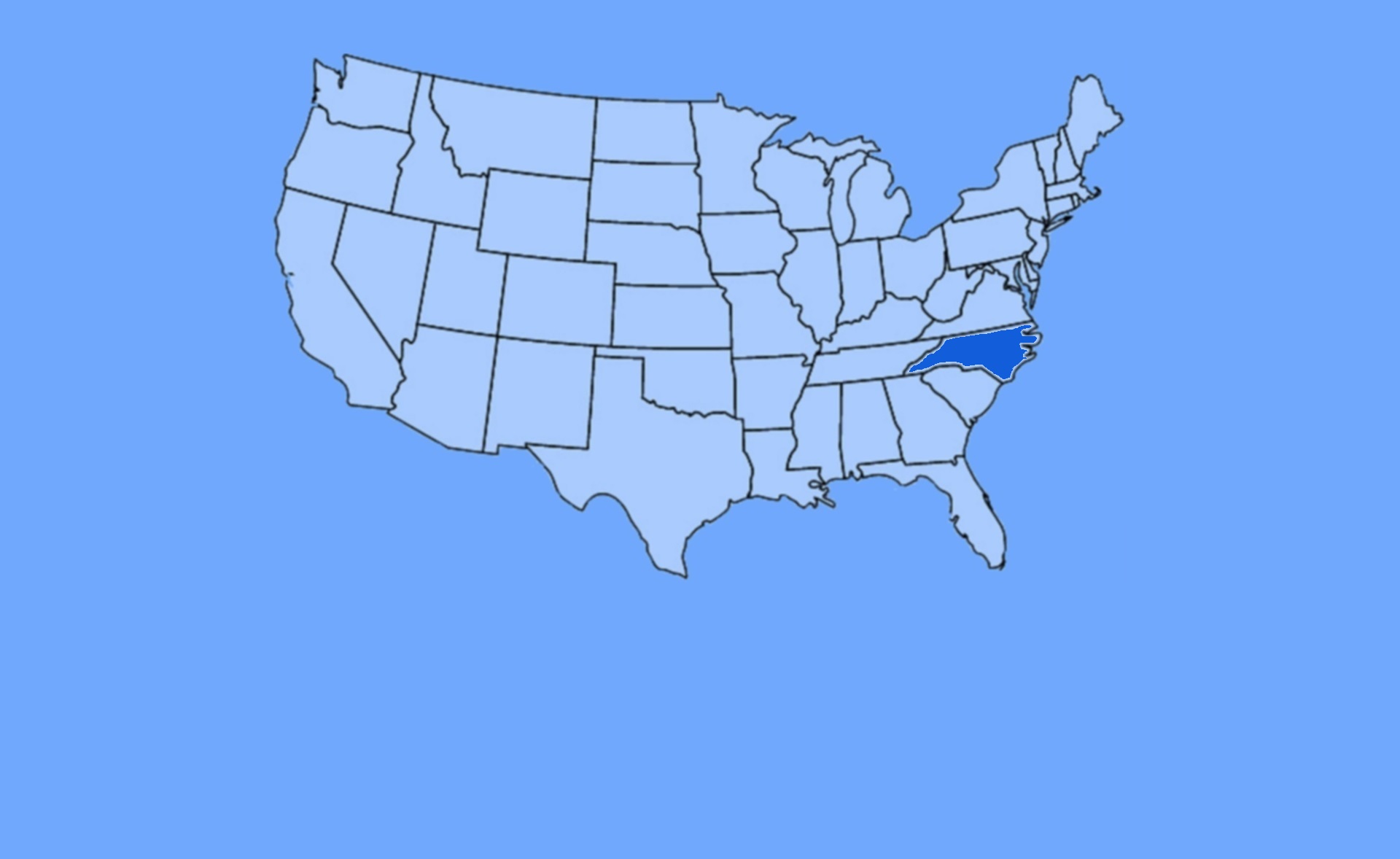
Pterodactyl sighting in North Carolina
On April 5, 2019, I uploaded to Youtube an 11-minute video on eleven sightings of apparent pterosaurs in North Carolina. Those are just some of the eyewitness reports that I have received from that state.
.
A Challenge for the Ptp “Civil War” Pterodactyl Photo and an Answer
After going over key areas of that article, on September, 26, 2022, and examining the episode itself, I made a discovery: Assuming I have not made a serious error, the author of the CWP article himself has not watched that episode with an eye to an important point that he seems to have tried to make in CWP . . .
.
Apparent Genuine Photo of a Pterodactyl
Although digital manipulation is highly likely to have been made on the original photo, in recent decades, we now have evidences that the “monster” in Ptp may have been a real animal.
.
Non-extinct flying dinosaurs
I am a scientist, and I have discovered that the great majority of eyewitness sighting reports of extant pterosaurs are neither misidentifications nor hoaxes; part of my conclusion is based upon the data from eyewitness estimates of wingspan.
.
Pterodactyl Caught on Camera in North Carolina
A few years ago, flying over the city of Raleigh, North Carolina, two ropens showed themselves in clear daylight and were videotaped by Cynthia Lee, as she was on a bus that was pulling away in the opposite direction.
.
Flying Dinosaurs in Papua New Guinea
From 1994 through 2009, about nine Americans have intermittently (and usually two or three at a time) visited remote islands of Papua New Guinea, searching for flying creatures: living pterosaurs.
.
Pterodactyl Sighting in Texas
Alex Salinas was looking out across a field in Weslaco, Texas, in around the year 1998, when he saw something flying towards him. . . . With a leathery appearance, it had a long tail and a bone-like head crest.
.